March 26, 2026
By
The wealth management stack is being rebuilt & we’re ready to back it
From fee revolt to full-stack: why AI-native wealth management is the next great venture opportunity

Building in wealth management has always excited us, yet despite hunting far and wide for companies in this space, we’ve found it hard to uncover many true gems. In a relationship business, it’s tricky to unseat incumbents and competition quickly becomes a customer acquisition battle which is always tough in the consumer space. That said, the rules are being rewritten and this time, we think there is a real opportunity.
The fee revolt
Something has fundamentally shifted in how people think about paying for investment management. Passive investing has quietly eaten active management’s lunch and 2023 was the watershed year, when passive US fund assets exceeded active for the first time in history, crossing $13.3 trillion against active’s $13.2 trillion.
Investors are increasingly more reluctant to pay for underperformance dressed up in relationship management. Fees that were once opaque are now scrutinised. The value proposition of traditional wealth managers, particularly in the mass-affluent segment, is under real and growing pressure.
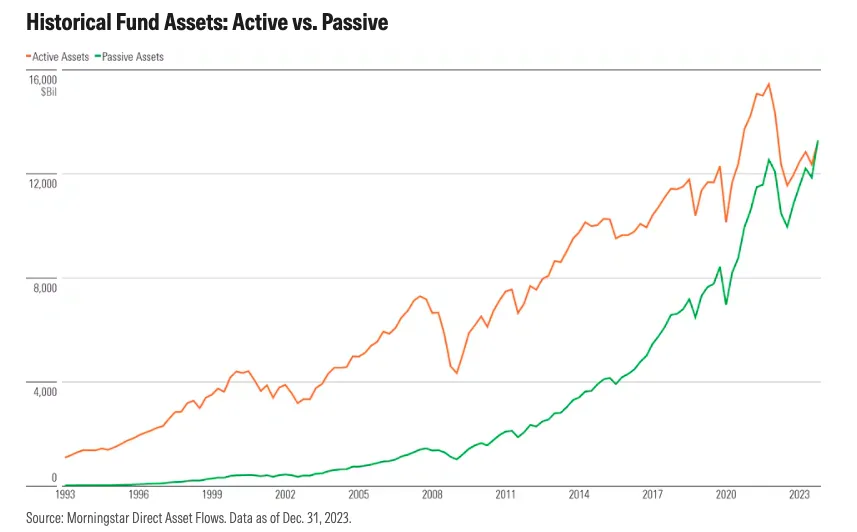
Morningstar Direct Asset Flows. Data as of Dec. 31, 2023.
A market bifurcating in two
The structural pressure on fees, combined with the maturation of AI, is accelerating a split that has been building for years. We see wealth management dividing into two distinct segments with their own competitive dynamics.
The second segment will continue to consolidate; NatWest’s acquisition of Evelyn Partners, announced in February 2026 and bringing its ~£60bn AUM under the bank’s umbrella, is emblematic of where this is heading.2 Scale is becoming a prerequisite to justify the infrastructure investment and for venture, the interesting territory is the first segment.
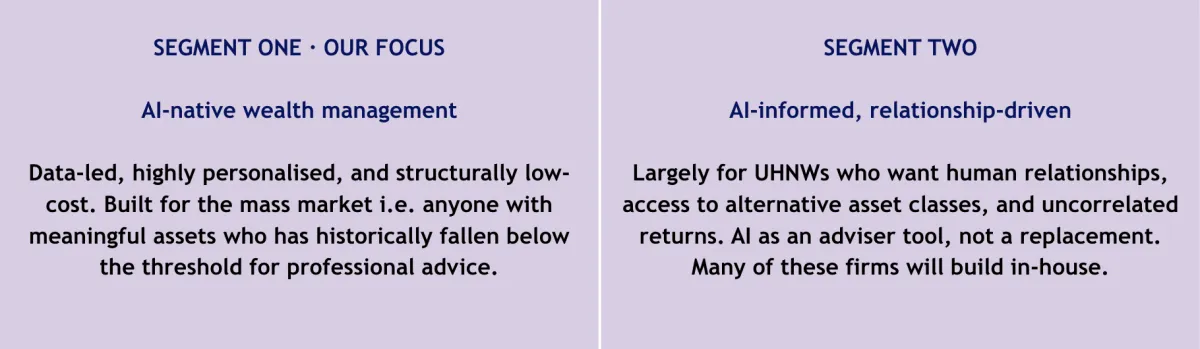
Two segments of wealth management
Where AI gets really smart: life stage personalisation
What makes AI-native wealth management exciting, and different from what came before, is the opportunity for deep personalisation at scale. Not a generic portfolio allocation, but guidance calibrated to who you are and where you are in life.
This is where the category becomes a real platform. The financial needs of a 24-year-old starting their investment journey are entirely different from those of a couple in their mid-thirties planning for a family, or someone in their fifties approaching peak earnings and thinking seriously about legacy. A traditional adviser serves maybe 100–150 clients across this entire spectrum. An AI-native platform enables them to serve more, and with a better service and on a very large scale, each customer will feel that they are the only one.
Layer in market events - a correction, a rate cycle, a geopolitical shock - and the intelligence required to respond with something genuinely useful, for each person’s specific situation, becomes formidable. Markets are becoming more short-term and volatile so the ability to deliver a calm, personalised signal through that noise, without requiring a human in the loop for every interaction, is where the real value lies.
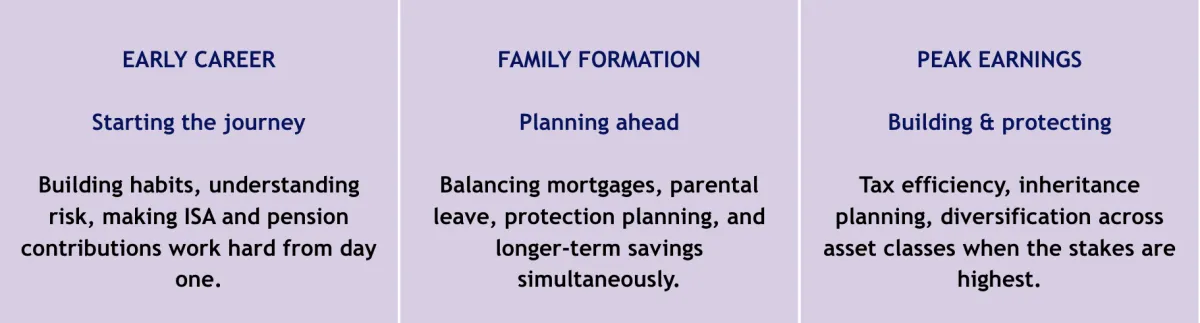
Stages of life
Why this time is different
The obvious question is: haven’t we been here before? The robo-advisers of the 2010s promised to democratise investing. Most delivered passive allocation with a cleaner UI. The gap between a model portfolio and genuine personalised guidance was wide, and users felt it.
What’s changed is the quality of the intelligence now available. Large language models, combined with improving financial data infrastructure, make it possible to engage meaningfully with the actual complexity of someone’s financial life. This is not just a risk questionnaire mapped to a model portfolio, but something far more contextual. That may be the inheritance coming down the line, the mortgage up for renewal or the market dislocation that demands calm, not panic.
Think of Vanguard’s low-fee philosophy married to cutting-edge intelligence with a platform that can navigate both life events and market volatility with the kind of personalisation that has until now required a trusted adviser on speed dial.
Life and market events have always been the moments that define wealth outcomes. They’ve also been the moments where, without a relationship adviser, most people have been on their own. The advice gap is vast: roughly 27,000 regulated financial advisers serving 67 million people in the UK but AI changes that ratio fundamentally.
The opportunity we’re watching
The most interesting companies being built in this space are not just better investment products, they are financial operating systems. Platforms that sit at the centre of someone’s financial life and provide intelligent, continuous guidance across all of it.
The competitive dynamics favour builders who do three things well. First, aggregate data: bringing together a fragmented picture across ISAs, pensions, property, and everything else. The plumbing required to do this reliably is foundational, whoever gets it right is positioned to power everything built on top. Second, generate trust: through transparency, track record, and increasingly through employer or bank distribution that borrows existing trusted relationships. Third, navigate regulation, the FCA’s Consumer Duty framework raises the bar on demonstrable consumer outcomes, which is a constraint for incumbents and a moat for new entrants who design for it from day one.
What we’re looking for
We back founders thinking about structural change rather than incremental improvement. In wealth management AI, that means teams who understand both financial services and AI deeply. This is not a space where you bolt one onto the other. Products with a clear answer to “why does the end user trust this?” and business models that work with the regulatory environment, not against it.
The company that wins this category will not just be a better investment platform. It will be the financial companion that most people have never had access to - one that understands their goals, responds to their life stage, and compounds quietly in the background across decades. That is a large and important opportunity.
We’re actively looking to back the team building it, if that’s you, get in touch.