Don't invest unless you're prepared to lose all the money you invest. This is a high-risk investment and you are unlikely to be protected if something goes wrong. Take 2 mins to learn more.

September 22, 2026

By Orissa

The Love Retreat Wrap Up: Finding Higher Ground

Takeaways on trust, talent and relationships from our first Love Retreat
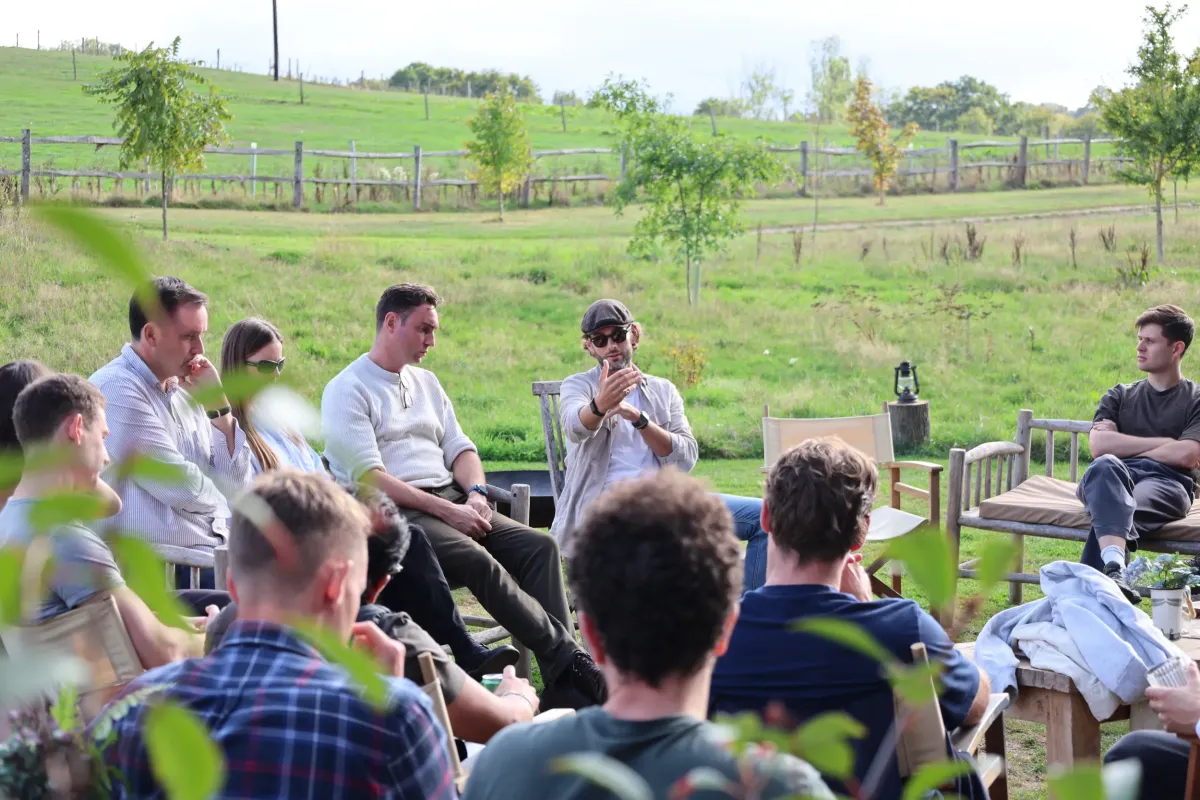
Last month, we brought around 50 founders, investors, advisers and friends of Love Ventures to the Surrey Hills for a night in yurts. From an outsider’s point of view, it might look like a bunch of 30-year-olds frolicking around in the field having a nice time but there was, in fact, far more to it.

It’s rare that we get to step away from our screens and sit with our thoughts and actually speak to people on a human-to-human level, as aside from the transactional conversations that tend to happen at most networking events. Some guests were working towards their first $1M in revenue whilst others were managing enterprise contracts, larger funding rounds and growing teams. We wanted to give each of them a chance to dive deeper into the topics on their mind and share their own snippets of knowledge, which they could not find on an LLM.

The question that kicked things off for all of us was if it is becoming easier for almost anyone to build a product, what does it take to build a company that lasts? If the building gets cheap, other factors get comparatively expensive and important. These include the people you hire, the trust you build with customers and the relationships around the business. None of these can be copied as easily as a product can.

Trust is the moat

We opened by asking where startups stand if frontier labs come to control the model, the app and the distribution. We heard phrases such as: “The labs will never understand people. The labs will never tailor.” They’ll never go after “extremely context-specific problems at no scale”: physical logistics, vertical software for restaurants, buildings and salons, and highly regulated markets. Whilst these ideas prove to strengthen a product against AI or even some of the labs, that is not to say they are not all immune from being eaten or copied, whereas trust can’t.

Trust came up again and again, perhaps unsurprisingly. In enterprise sales, buyers needed confidence that a young company would deliver since they themselves as decision makers are often held liable. Tembo took six months to make its first sale. The time it took to gain trust from customers allow it to make meaningful decisions on their behalf was not affected by the speed of building. Products can now be built in weeks but trust still takes months, so start earning it before you need it. It’s earned by people: the team who understands the customer, makes good calls and delivers, which puts the spotlight back onto the team.

Judgement is the talent advantage

We are now seeing more and more teams shrink the knowledge gap between all areas of the business. Engineers own products from the first customer call through to shipping and maintenance, while agents triage requests and prepare smaller fixes. For example Pac @round stated from the perspective of an engineer: “this is my baby. If it’s not working, I’m staying up till 5 AM to get this done.” Engineers care more because they see the product through from start to finish. However, does this eliminate the need for a product manager to asign information that AI can now assist with? Engineers spending more time on product decisions need a good understanding of the customer and judgement.

This idea of sound judgement is increasingly important not just at a holistic level but also against the limits of LLMs. Adam’s session gave the example of a CFO asking the same financial question on different days and getting different answers. The model will always give you an answer, so someone on the team needs to be able to tell whether it is right before acting on it. That judgement usually comes from experience. A CFO who has closed the books will notice when a number looks wrong, and someone who hasn’t probably won’t. For founders, that means hiring people who know the area well and understand it on a deeper level, and not only people who are quick with AI tools.

The catch is that AI makes also makes those people harder to find. Just as a model always gives an answer, a candidate using AI can always hand in a polished take-home. Matthew from Jumpstart said that kind of task now tells you very little. He suggested asking candidates to talk through how they used AI, including what they prompted, what they changed and where they disagreed with it. That shows whether they can tell when the AI is wrong, which is the judgement you’re hiring for.

Know what sits beneath the number

A polished take-home can hide a weak candidate if they don't understand it, and a big revenue number can hide a weak business. The commercial breakouts started with $1M ARR, which many founders treat as a target and on its own, doesn’t tell you much. What matters is whether customers want the product enough to keep buying it, and whether there are many more customers like them.

To see that, you have to look at what makes up the number. Nick Katz from RAISE suggested founders break their ARR down into committed contracts, usage, pilots and services, because investors don’t see these as equally reliable. A pilot, for example, is useful - it teaches you about the customer, and a well-known name helps when you pitch to others. It doesn’t mean that customer will keep paying. Founders should be able to explain exactly where their ARR comes from and what they can do to grow it.

Find who makes the decision

Revenue only grows if deals get signed, so founders spent a lot of time on who actually signs them. They called this person “Caesar”, the one who can approve the deal. Your keenest contact often doesn’t hold the budget, and someone you’ve never met might be able to say no. The advice was to find out early who decides and focus on them. Mapping the whole buying process helps with this. One company did it, found 29 steps, and cut one of them, the security questionnaire, from a week to under an hour.

Knowing the right people matters outside of sales too, and it’s the reason we brought this group together. Several founders said it helped to realise their problem isn’t just their problem, as everyone else is in the same boat. It was a chance to zoom out from the day-to-day, take stock, and go back in.

Good people help you win customers, and good relationships help you grow. People, relationships and talent are a flywheel.

Thank you to everyone who joined our first Love Retreat. We look forward to doing it again in 2027.