Don’t invest unless you’re prepared to lose all the money you invest. This is a high risk investment, and you are unlikely to be protected if something goes wrong. Learn more.

July 29, 2026

Seven Prime Ministers in Ten Years: What a Burnham Government Could Mean for Your Money

His inheritance tax and income tax plans have been public knowledge for over a decade, here's what they could mean for your clients' portfolios.
Andy Burnham became Prime Minister last week. Within days, the tax policies he's championed for two decades (both during his time as an MP and as Mayor of Manchester), an inheritance tax overhaul, a shake-up of council tax, and tinkering with CGT, are back on the table. It remains to be seen whether any of it survives contact with the Treasury.

Yet amidst the turmoil, there are clear policy ideas starting to surface. Let's look at what tax changes the new administration might pursue, and what they could mean for you and your money.
Inheritance Tax

Mr Burnham, or "Andy" as he's asked us to call him, has form here. As Health Secretary under Gordon Brown in 2009-10, he backed proposals for a compulsory charge on estates, with the proceeds ring-fenced for social care, later being forced to drop it after the Conservatives successfully labelled it as a ‘death tax’.  

It looks like this is about to become political reality now he is PM as he has stated his intention of a 10% levy on all estates to fund Social Care. The previous Labour government also came under serious criticism with their move to include pensions into one's taxable estate from April 2027. 

We can argue until we are blue in the face about the political and societal merits of this policy, but it will force individuals and advisors to think differently about how they hand their wealth down to the next generation. Gifts and trusts are the most used methods of IHT mitigation, but EIS is often left to one side. This proposed policy change probably has the highest chance of increasing flows to the asset class. Provided they are held for two years, EIS investments are free from IHT which, when factoring in the capital gains exemption, makes this a compelling option for those thinking about what comes next. 

Property Tax Revamp

Perhaps the most overdue reform on the table is how we pay council tax. Governments have teased the prospect of reform ever since Michael Heseltine introduced it in 1991. None have touched it, because revaluing thirty years of house price growth will lead to loud criticism from a select few, despite it arguably benefiting more people than it harms. That does not mean people won’t feel the impact of it to their bank balances, but perhaps a visitation of the system is long overdue. 

There's also talk of revisiting stamp duty, which Burnham has reportedly described as a tax on the aspirations of young people, a view with which I have some sympathy. Less palatable, if the reports are accurate, is his proposed alternative: a property tax of 0.48% of a home's value, which would push up bills by thousands of pounds a year for homeowners in London and the South East. It does seem unfair that multi-million pound properties in London are paying less council tax than a home worth half as much elsewhere in the country. There are of course nuances at play (not everyone who lives in a house worth a sizable sum of money is going to be wealthy), but this seems like a gamble the government is willing to take. We bemoaned the lack of big decisions being made in the previous administration, let’s see how this one pans out. 

With a big increase in sales of buy-to-let flats, (2025 saw a record number of former rental properties sold), there will be plenty of people to whom HMRC will come knocking armed with sizable CGT bills. However paradoxically, higher CGT does not necessarily mean higher investment into tax efficient asset classes. More on that below.

Capital Gains Tax

This is the big one. Under current rules, an estate's assets are "uplifted" to market value on death, so CGT applies only to gains made after death, not during the deceased's lifetime. If the talk of scrapping that uplift is accurate, it would hit families hard.

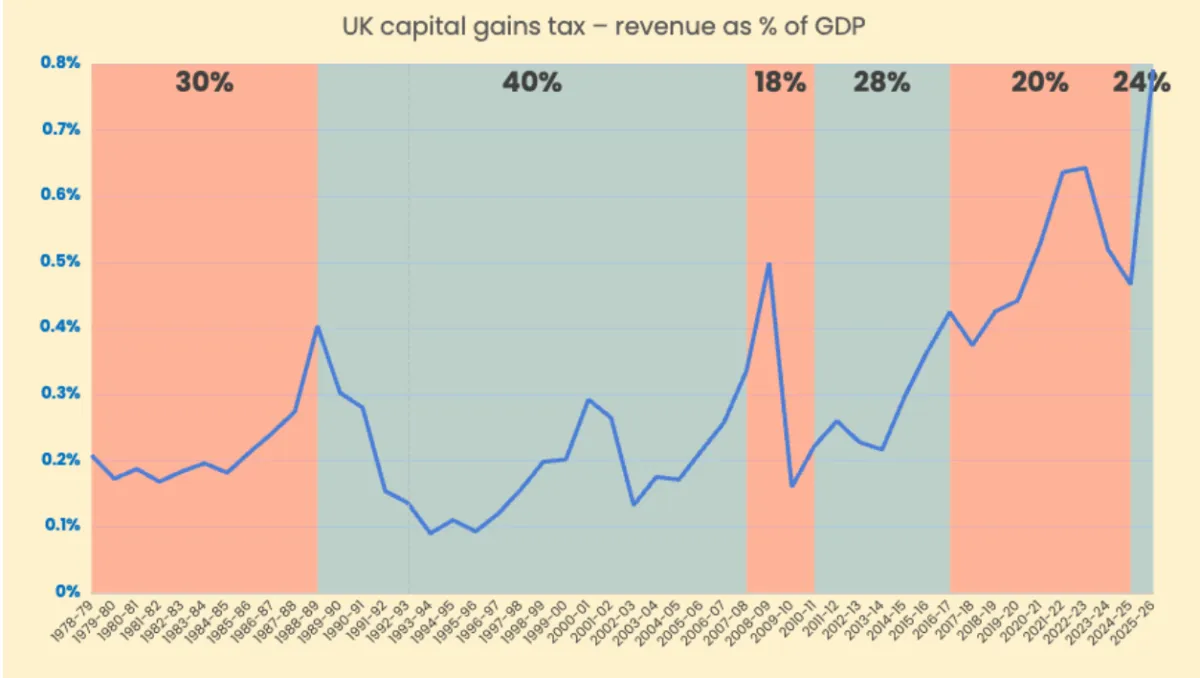
There's also talk of aligning CGT with income tax rates. As an EIS fund manager, the instinctive assumption is that this would push more capital toward the asset class, given its CGT exemption and deferral reliefs. In practice, that's rarely how it plays out. When investors see a CGT rise coming, they tend to either sell early to lock in the lower rate, or sit tight and wait for a friendlier tax environment. Either way, the anticipated rise itself changes behaviour before it's even introduced. Which is the uncomfortable truth for anyone hoping tax rises are a straightforward sales tailwind for our asset class: they're not,

Source: History of Capital Gains Tax, taxpolicy.org.uk

Income Tax

Burnham has long backed raising the additional rate of income tax from 45p to 50p. We saw what happened when Liz Truss and Kwasi Kwarteng dabbled with the income tax bands in 2023. With Andy promising he wouldn’t be held hostage by the bond markets, it will be interesting to see whether he sticks to his guns. 

Alongside this, there's talk of reintroducing a 10p starting band for the lowest paid, an idea Gordon Brown trialled in 1999 before scrapping it in 2008, arguing there were better tools to tackle poverty.

What Does It Mean for Retail Investors?

For EIS, a change to CGT would move the needle the most, but as above, CGT rises rarely translate into higher investment. A rise in the additional rate of income tax could have more effect, since EIS income tax relief becomes worth more in absolute terms as your top rate climbs, sharpening the incentive to shelter income.

Nevertheless,  what really drives our asset class is investor confidence. If the government wants to stimulate growth, the most useful thing it can do is state clearly that (S)EIS and VCTs are here to stay.

Ultimately the proof will be in the pudding, but if there's one thing investors hate, it's uncertainty. The last administration's habit of drip-feeding policy changes through the press caused real disruption last year, not least with the floated "exit tax" that never materialised. If tax changes are coming, they need to be announced early enough for people to plan around them.

My guess? CGT and IHT changes will grab the headlines but what will really move the needle for retail investors is stability. Chance would be a fine thing…